 Sahni
Guides · with Sahni Premium
A week of movement, planned safely.
Coach's activity plan asks how you move today, then plans a week of sessions you can do safely, each one shown move by move.

A few questions first
The plan starts with some safety questions, your blood pressure if you know it, your bones and joints, the equipment you have and how long a comfortable walk is for you. You can answer them during setup, from Coach or in your profile.
Your starting level
Your starting level is set once, from the activity your iPhone has recorded. Three weeks in which you meet the plan move you up a level. An empty week moves you down only if a workout was recorded in the four weeks before it, since an empty week can also mean the data wasn't shared.
How the week is laid out
Hard days are spread out, never two in a row, and moving or swapping a session keeps them apart. When you have a condition, the plan takes the lower intensity and the more frequent schedule of the advice for it.
Each session, move by move
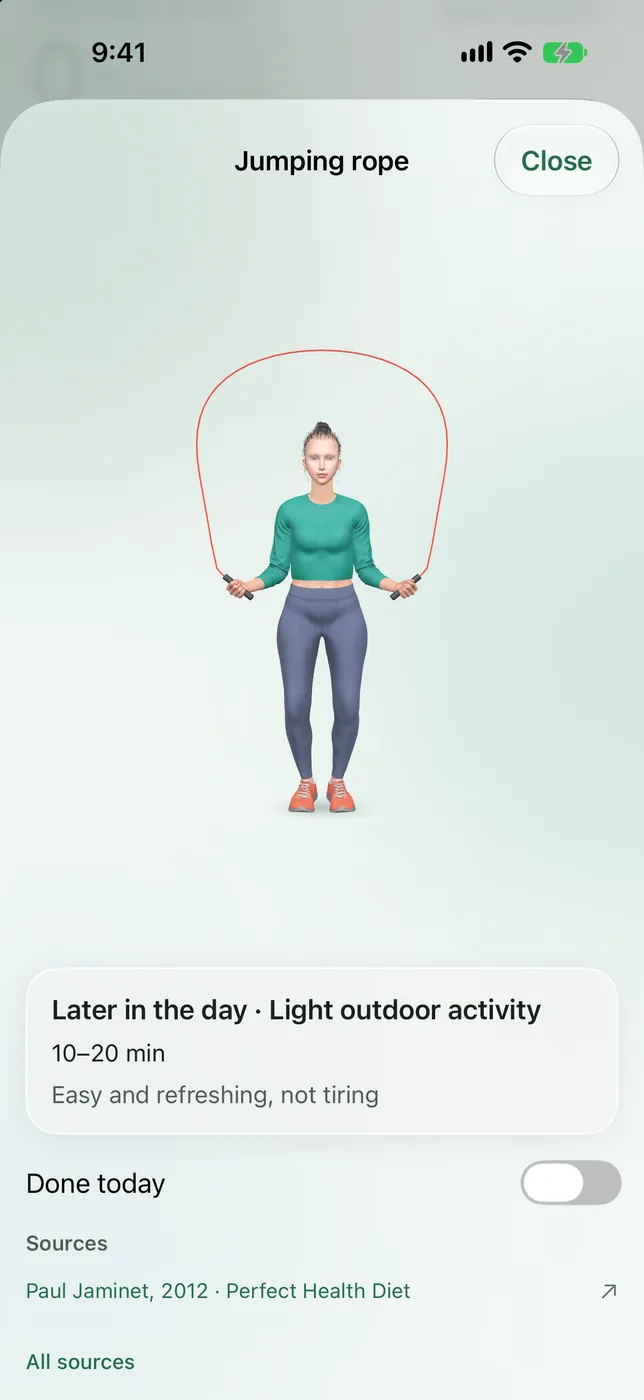
Tap a session's name and Kaitlin, Sahni's 3D coach, shows it on a small stage with the equipment it needs, from a mat or a kettlebell to a pool. The sheet gives the dose, a "Done today" switch and the sources.
Ticking sessions off
Workouts you record mark the planned session they can stand for: a run for a cardio session, a strength workout for a strength one. Your own tick always wins, and a session you untick stays unticked for the week. A workout that doesn't match a session changes nothing.
"Feeling unwell" turns the whole day into light, restful activity, and a hard session moves later in the week if it can stay apart from the others, or to next week. When Coach's recovery check comes back low, only the hard session turns restful. The check holds for the whole day, and a session you've already ticked is never swapped.
When a hard day moves your targets
Some sessions are planned as full effort, such as intervals or strength work close to your limit. When you log one, that day's calories rise by about a quarter; logged from 6 pm, the next day's rise instead, if it's in the same week. The rest of the week then trims back by up to a quarter to pay for it, never below your floor. Your saved targets don't change, and a line under today's calories says why.
Who gets a lighter plan
Anyone with an eating-disorder history gets no activity plan, and a clinician hold applies to the plan too. A BMI under 18.5, supervised type 1 diabetes, dialysis, pregnancy, a condition the source books don't prescribe for, a yes to any safety question, or blood pressure above 200/115 (180/110 untreated) get light daily activity only.
Sources
- ACSM's Exercise Management for Persons With Chronic Diseases and Disabilities, Third EditionAmerican College of Sports Medicine; J. Larry Durstine, Geoffrey E. Moore, Patricia L. Painter, Scott O. Roberts (eds.), 2009
- Exercise Physiology: Theory and Application to Fitness and Performance, Fourth EditionScott K. Powers, Edward T. Howley, 2001
- The New Evolution Diet: What Our Paleolithic Ancestors Can Teach Us about Weight Loss, Fitness, and AgingArthur De Vany (afterword by Nassim Nicholas Taleb), 2011
- Perfect Health Diet: Regain Health and Lose Weight by Eating the Way You Were Meant to EatPaul Jaminet, Ph.D., and Shou-Ching Jaminet, Ph.D. (foreword by Mark Sisson), 2012